From hours of Photoshop to a few seconds
A convincing face swap used to be a specialist job. You matched angles by hand, masked hairlines frame by frame, and corrected skin tones until the composite stopped looking pasted on. Modern AI face swaps compress all of that into a single pass that finishes in three to five seconds.
The difference is not just faster software. The work has been moved from a human editor to a model that learned what a face is from millions of examples.
Step one: finding the face
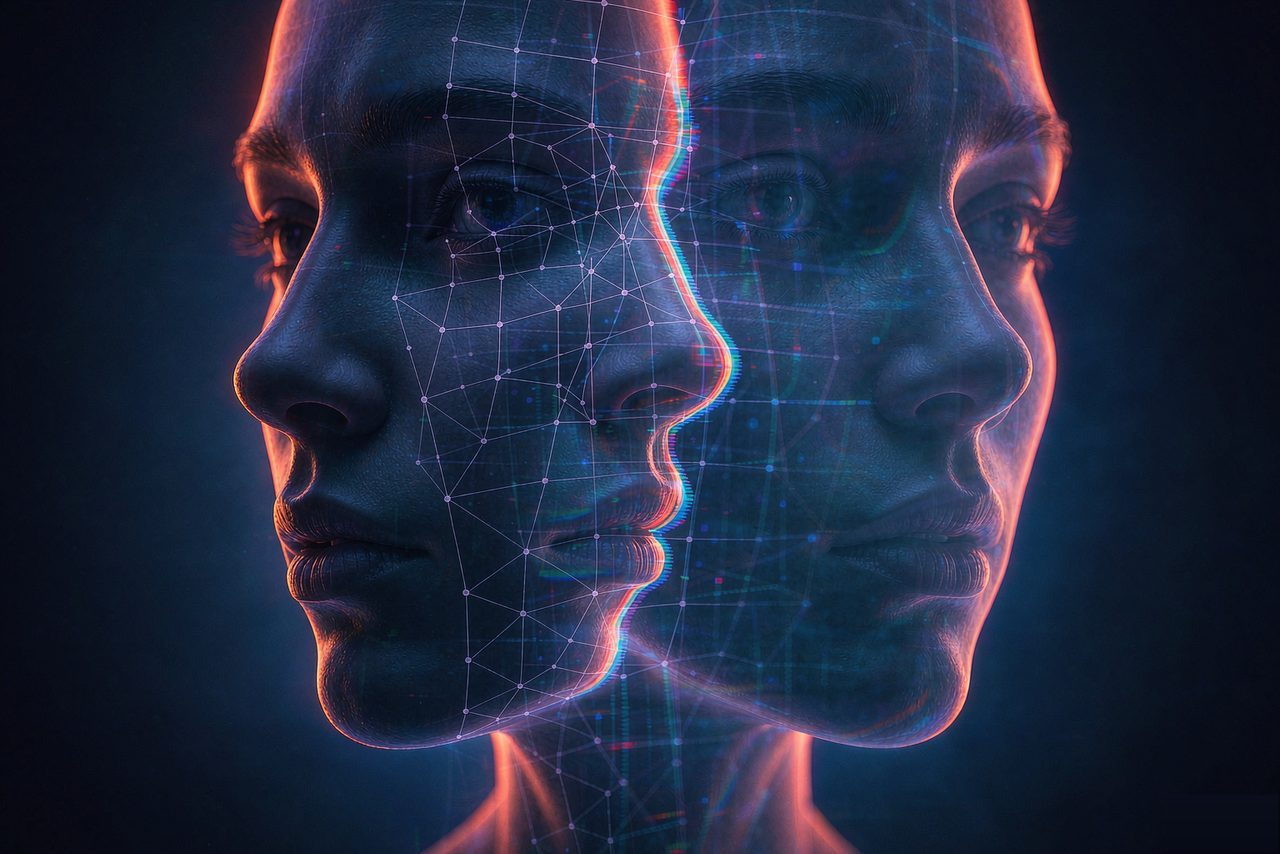
Every pipeline starts with detection. A facial recognition network scans the uploaded portrait and returns a set of landmarks: eyes, nose bridge, mouth corners, jawline, eyebrows. Those points define a mesh that tells the system exactly where the face is and how it is oriented.
Landmark quality decides everything downstream. A sharp, front-facing portrait gives the detector a clean mesh to work with; a blurry or heavily angled photo forces the model to guess, and you see that guess as a glitch in the final image.
Step two: understanding identity
Next, an identity encoder summarizes the face into a compact mathematical signature: the distance between the eyes, the shape of the jaw, the curve of the lips, the texture of skin. Two faces with similar signatures will look like relatives; two very different signatures look like different people.
The swap engine learns to transfer this signature while leaving everything else untouched: the pose, the lighting direction, the expression, the hat, the sunglasses. That separation between identity and scene is what makes a modern swap look natural where older tools looked like stickers.
Step three: blending and refinement
The last stage is generative refinement. A diffusion or GAN-based network redraws the boundary zones: hairline, jaw edge, the shadow under the chin. It matches grain, color temperature and lighting so the new face sits inside the photo instead of on top of it.
This is also where upscaling happens. The refined output is sharpened to HD before delivery, which is why a clean swap holds up even when the meme is re-screenshotted and re-compressed across social platforms.
What it means for creators
Because the whole pipeline runs server-side, the barrier is no longer skill or expensive software. The only real inputs that matter are a decent source portrait and a good idea.
That is the shift: the tool stopped being the bottleneck, so taste and timing became the craft. Everything else on this blog is about those two.